






WhatsApp Us

Lower Your Handicap
on Your Home Course

The technical work matters. The fitness work matters. But the score on the card comes down to what happens between your ears — and that’s the part most golfers never train.

The Coaching Team

Four Coaches. One Direction.

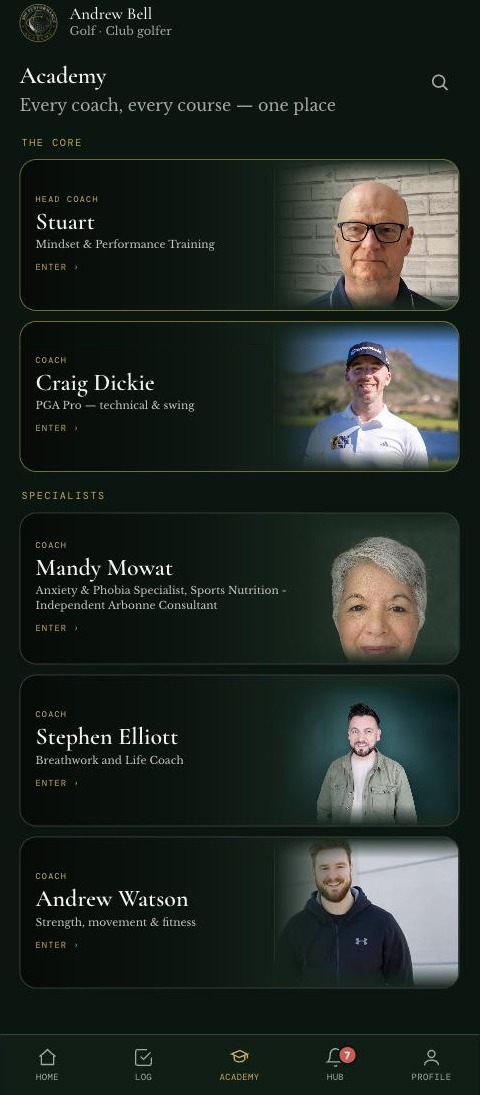
360 Golf isn’t built around one voice. It’s built around four specialists working in the same direction — so the technical, mental, physical, and subconscious sides of your game stop competing and start compounding.

Stuart Robertson
Mental Performance
Stuart Robertson

Stuart is the founder of 360 Performance Academy and the architect of the 360 Golf system. His work sits at the intersection of identity, belief, and behaviour — specifically, the patterns that show up under competitive pressure on the course. The mental side of golf is not a supplement to your game. For most players, it is the game. Stuart’s approach is evidence-based, structured, and built around who you are as a player, not a one-size-fits-all template.

Craig Dickie
Technical · PGA Professional
Craig Dickie

Craig is a PGA professional whose coaching is built around one principle: the technical work has to hold when the pressure is real. Swing mechanics, ball striking, short game, course management — Craig provides the technical foundation that doesn’t dissolve the moment the medal card comes out. His approach integrates directly with the mental and physical work, so changes made on the range carry over to the round that matters.

Andy Watson
Fitness · TPI Certified
Andy Watson

Andy is a Titleist Performance Institute (TPI) certified golf fitness specialist. The physical side of golf is consistently underestimated by recreational players. Mobility, stability, and golf-specific conditioning don’t just reduce injury risk — they directly influence ball striking and the ability to sustain focus and form across 18 holes. Andy builds the physical platform that everything else depends on.

Mandy Mowatt
Hypnotherapy & Nutrition
Mandy Mowatt
Nu-Yu Health & Mind

Mandy brings two disciplines that most golfers have never considered as performance tools: clinical hypnotherapy and sports nutrition. The subconscious patterns that surface on the 17th tee, the energy that drops on the back nine, the recovery habits that determine how quickly you adapt — Mandy works on the parts of your game that are invisible until they aren’t. Her practice, Nu-Yu Health & Mind, is woven into the 360 Golf system.

“Mental training is essential in golf. When I visualise success and believe in my abilities, I can achieve remarkable results.”

Tiger Woods  ·  15× Major Champion

The System

A Player Pathway, Not a Course Library

Most online golf coaching is a pile of videos with no order. 360 Golf is the opposite. You enter, you take the player type quiz, and from there your path is structured.

01
Start Here — Free
Take the Player Type Quiz

Ten questions. Five minutes. The quiz identifies how you naturally think, compete, and respond under pressure on the course. Your player type shapes everything that follows — it determines which 18-lesson course is yours, how Stuart reads your monthly data, and how the coaching is framed around who you actually are.

10 questions · 5 mins · Free for everyone
02
Your Foundation
Work Through Your 18-Lesson Course

Your player type unlocks a specific 18-lesson course built for how you think. Not a generic module that every member takes — a structured sequence designed around your mental patterns. The lessons build on each other. The sequence matters. Work through them in order.

18 lessons · Specific to your player type · Structured sequence
03
Go Deeper
Access the Full Module Library

Beyond your core course, the library covers the full range: pressure management, pre-round preparation, recovery after a bad hole, managing expectation in competition, the mental mechanics of putting. Work through what your game needs when it needs it.

Expanding library · Technical, mental, fitness, and mindset content
04
Stay Connected
Engage with the Community

Monthly live sessions, direct coach Q&A, and a community of golfers working the same system. The work you do alone on the range is important. The conversations that clarify why something isn’t landing are often more important. Both exist here.

Live sessions · Coach Q&A · 30+ members
2025 Season Bonus — Included for Skool Members
2025 Only — Skool Member Bonus

Know Your Home Course Inside Out

Your home course knows you. The 4th green where you always three-putt. The 11th tee where you always block right. The back nine where the wheels come off when the card matters. This is where the work shows up — not on the range, on the round that decides your monthly medal.

The Home Course Stats Report turns one season of scorecards into evidence-based intelligence about your game. Damage holes identified. SI mismatches mapped. Segment patterns exposed. Five priority actions for the season ahead. This is the precision that turns general practice into targeted improvement.

Example — Home Course Stats Report — All figures are illustrative · Mid-handicap player · 18 rounds
360 Performance Academy · Home Course Season Analysis
Player A
Parkland Golf Club Handicap 16 2025 Season Yellow Tees · Par 71
18
Rounds
88.4
Avg Score
+17.4
Avg Over Par
82
Best Round
Damage Holes — Where Your Card Breaks

These are the holes where your average score is worst relative to par, calculated across 18 recorded rounds this season. Not the hardest holes on the course — the holes that are hardest for you. The distinction matters.

Top 5 Damage Holes — avg over par across 18 rounds
Hole 7 · Par 4 · SI 11 avg +2.4 over par
Hole 14 · Par 3 · SI 16 avg +2.1 over par
Hole 4 · Par 5 · SI 4 avg +2.0 over par
Hole 11 · Par 4 · SI 6 avg +1.9 over par
Hole 17 · Par 4 · SI 2 avg +1.8 over par
Banker Holes — Consistent Performers
Hole 3 · Par 4 · SI 13 +0.7 avg
Hole 10 · Par 4 · SI 9 +0.8 avg
Hole 6 · Par 3 · SI 17 +0.9 avg
Hole 1 · Par 4 · SI 15 +1.0 avg
Hole 18 · Par 5 · SI 8 +1.1 avg
Pattern identified. Banker holes are spread across both nines. Damage is concentrated on holes 7, 14, and 11 — all require a controlled approach under tree pressure. The damage is positional, not physical.
SI Mismatch — Where Official Difficulty Disagrees with Yours

The official Stroke Index is set for the average player. Your personal SI, derived from 18 rounds of data, shows where the course is genuinely harder or easier for you specifically.

Hole Par Official SI Personal SI Shift Avg vs Par Flag
7411 2 +9 +2.4 Much harder
14316 4 +12 +2.1 Much harder
1146 3 +3 +1.9 Harder
3413 16 −3 +0.7 Easier
1858 14 −6 +1.1 Much easier
SI mismatch identified. Hole 14 (Par 3, SI 16) is officially rated as one of the easiest on the course. For this player it is the second most damaging. In a stableford competition, this hole is receiving no stroke — yet it averages +2.1 over par. That is a systematic disadvantage on a supposedly easy hole.
Segment Fatigue — Where Your Round Falls Apart
SegmentHolesParAvg ScoreAvg vs Par
F9 Opening1–31215.1+3.1
F9 Middle4–61114.8+3.8
F9 Closing7–91216.9+4.9
B9 Opening10–121114.0+3.0
B9 Middle13–151114.6+3.6
B9 Closing16–181216.4+4.4
F9 Fatigue Index
+1.8

Score deteriorates by +1.8 shots per 3-hole segment across the front nine. The closing three holes (7–9) average nearly two shots worse than the opening three.

B9 Fatigue Index
+1.4

Back nine deterioration is present but lower than the front nine. The B9 opening segment is the strongest on the course, suggesting the turn resets something mentally.

Score Distribution — 18 Rounds · 324 Holes
Birdie or better
4

1.2% of holes

Par
68

21% of holes

Bogey
142

44% of holes

Double+
110

34% of holes

Birdie
 
4
Par
21%
68
Bogey
44%
142
Double
26%
83
Triple+
8%
27
High-score contamination. Triple bogey or worse accounts for 8.3% of holes — but contributes disproportionately to handicap damage. Removing just 14 of those 27 triple-or-worse holes and replacing them with bogeys would reduce average score by approximately 1.5 shots. The priority is blow-up elimination, not birdie creation.
Season Trajectory — Month by Month
Apr
+21.3 avg
3 rounds
May
+19.8 avg
4 rounds
Jun
+18.1 avg
3 rounds
Jul
+16.4 avg
3 rounds
Aug
+15.4 avg
3 rounds
Sep
+13.6 avg
2 rounds
Consistent improvement across the season. Average score over par dropped from +21.3 in April to +13.6 in September — a reduction of 7.7 shots across six months of structured work. This is real, measurable progress. Six shots off your handicap in one season is not a hypothetical — this player is evidence.
Five Priority Actions — 2026 Season

Derived from 18 rounds of data. These are not generic tips — they are specific recommendations built from your specific damage patterns.

1
Build a specific pre-shot routine for Holes 7 and 14. These two holes alone account for +4.5 shots per round above expected. Both share a similar profile: a technically demanding shot where the mental approach breaks down before the swing starts. The fix is not technical — it is pre-shot and positional.
2
Address triple bogey elimination before anything else. 27 triple-bogeys-or-worse in 18 rounds is the single biggest source of handicap damage. A consistent strategy for playing out of trouble — not heroic recovery, deliberate damage limitation — is worth more than any swing change this off-season.
3
Build a reset routine for Holes 7–9 specifically. The closing three holes of the front nine are where the round deteriorates most consistently. The data suggests this is a momentum pattern, not a skill deficit — something goes wrong in holes 4–6 and is carried forward rather than reset.
4
Reassess club selection and strategy on SI mismatch holes. Hole 14 is officially SI 16 — you are receiving no stroke — yet it averages +2.1 over par. A conservative par-with-a-bogey-acceptable strategy on this hole in stableford is a rational structural change that requires no swing improvement.
5
Protect the back nine opening segment. Holes 10–12 are your strongest segment on the course, averaging just +3.0. The turn resets something. Build a deliberate mental bridge between the F9 finish and B9 start that locks in this pattern rather than leaving it to chance.
Player Plus Golf

The Monthly Report

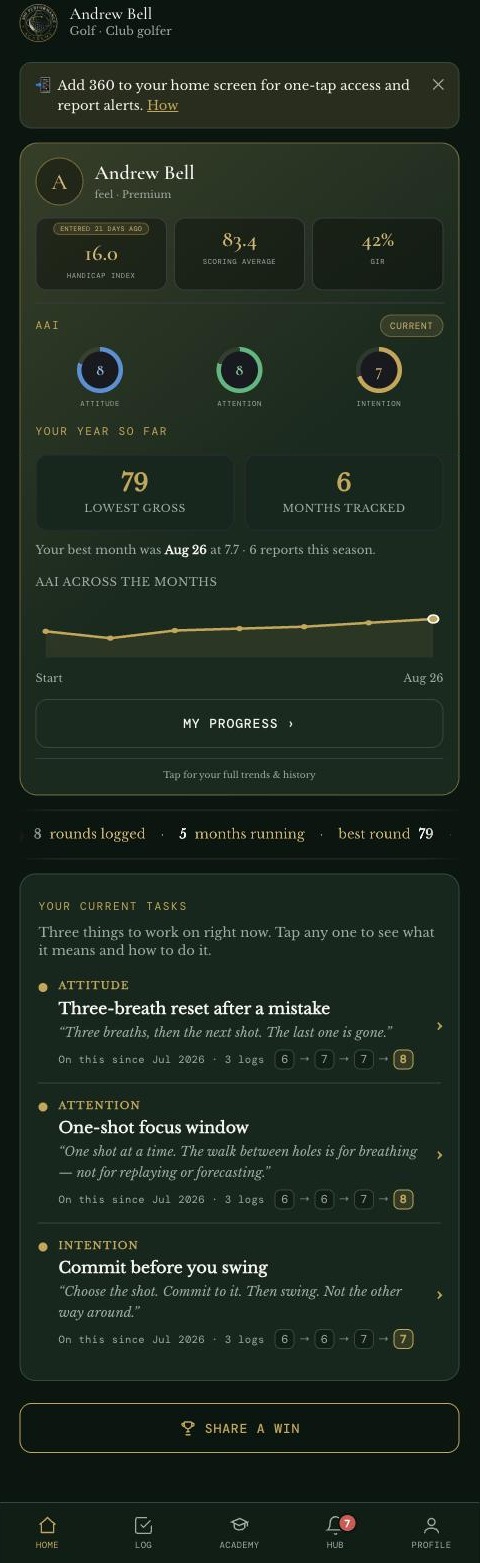
Every month, your three performance pillars are scored, tracked, and interpreted. Attitude, Attention, and Intention — each out of 10, each with a coaching task built from your data. This is not a general newsletter. It is a document built around your specific numbers, your specific patterns, and what they mean for the work ahead.

EXAMPLE PREVIEW — Illustrative only. Full Player Plus reports contain significantly more depth and detail than shown here.

Example — Player Plus Monthly Report — All figures are illustrative
360 Performance Academy · Golf
Monthly Performance Report
Player A · April 2026 · Handicap 16
Attitude · Attention · Intention — April 2026
Attitude 7 /10
Commitment to process7/10
Response to poor shots6/10
Emotional regulation8/10
vs previous month+1
This month’s focus
After any double bogey or worse, walk to the next tee using your reset phrase before touching the scorecard.
Attention 7 /10
Pre-shot routine held6/10
Focus under card pressure6/10
Target clarity at address8/10
vs previous month+1
This month’s focus
On Holes 7 and 14, hold attention on the landing zone for one full breath before addressing the ball.
Intention 8 /10
Tasks completed4 / 4
Behavioural rules held3 / 4
Measures tracked5 / 5
vs previous month+1
This month’s focus
Complete the attention-anchoring session twice — once at home, once before a casual round. Note which transfers better.
Six-Month Performance History
Month Attitude /10 Attention /10 Intention /10
November656
December667
January667
February767
March777
April — current778
Season Trajectory — Three Pillars
Attitude
Attention
Intention
Coaching Insight — April 2026
Stuart’s Analysis
Your Intention pillar has reached its highest point this season — four from four tasks, three of four behavioural rules held under competition conditions. The pre-shot routine work is becoming automatic on the back nine. Where the attention data is telling me something different is in the front nine closing holes. You are holding the routine through the card, but the data shows attention narrowing onto outcome when the score is on. We are going to work directly on that pattern over the coming month. The trajectory across six months is clear. The question now is whether we can break through the Attention ceiling at 7 that has resisted for two months.
April Coaching Tasks
1
After any hole where you score double bogey or worse, walk to the next tee using a specific reset phrase before touching your scorecard. One word in your log after each round confirming it was used.
2
On Holes 7 and 14 specifically, complete your full pre-shot routine and hold attention on the landing zone for one full breath before addressing the ball. No exceptions on these two holes.
3
Complete the attention-anchoring session from the workbook twice this month — once at home, once at the course before a casual round. Note which version feels more transferable.
Next Month’s Focus
Key Learning — Into May

Stay in the process. The card takes care of itself when the routine does.

Attitude — Continuing

After any double bogey or worse, walk to the next tee using your reset phrase before touching the scorecard. Extend into competition rounds this month — the task has proven itself in practice. Now test it when the card matters.

Attention — Priority for May

On Holes 7 and 14, hold attention on the landing zone for one full breath before addressing the ball — no exceptions. Track compliance one word per round in your log. This is the pattern we break through the Attention ceiling on.

Intention — Continuing with Addition

Intention at 8 confirms the belief is holding. Add one pre-agreed landing area decision for your key approach hole before each round. One club, one window, written on the card. This converts the Intention score into a specific, trackable commitment.

Personal Message from Stuart — April 2026

Six months ago your Attention score was 5. This month it is 7. That is not a coincidence and it is not a gift — it is the result of consistent work on something that was genuinely difficult for you.

The pattern we identified in November, where attention pulled away from process the moment the card was in play, has measurably shifted. It has not disappeared entirely, and the Holes 7–9 data shows it is still present in specific conditions. But the baseline has moved. That matters.

What I want you to focus on this month is not improvement — it is consolidation. The ceiling on Attention at 7 is real, and trying to push through it directly tends to create the kind of outcome focus that created the problem in the first place. Trust the tasks. Trust the system. The number will follow.

Stuart

“Confidence is the most important single factor in this game, and no matter how great your natural talent, there is only one way to obtain and sustain it: work.”

Jack Nicklaus

Player Plus Golf

The Post-Competition Report

After a competition, the data matters more than the feeling. The Post-Competition Report breaks down your round results, tests whether your coaching tasks held under real pressure, identifies the key moments and decisions, and extracts what the round actually tells you about where you are.

EXAMPLE PREVIEW — Illustrative only. Full Player Plus reports contain significantly more depth and detail than shown here.

Example — Post-Competition Report — All figures are illustrative
360 Performance Academy · Golf
Post-Competition Report
Round Review & Mental Performance Analysis
Post-Competition
Player A · Handicap 16 Club Monthly Medal · April 2026
Round Results

Monthly Medal — Net 71 · Gross 87 · +1 Stableford

Format: Stableford
Course: Parkland GC
Feeling after: Mixed · 6/10
Front 944+8 vs par
Back 943+9 vs par
Gross87+17 vs par
Net71Net even
Task Accountability — Did the Work Hold?
Attitude 7
Held
Emotional reset after Hole 7 double — executed. Response was deliberate rather than reactive.
Attention 6
Partial
Pre-shot routine held on back nine. Front nine closing holes (7–9) showed the familiar attention-shift pattern under scorecard pressure.
Intention 8
Held
Landing zone focus held at address on 15 of 18 tee shots. The three exceptions were Holes 7, 8, and 14 — the known damage holes.
Key Moment Analysis
Moment 1 · Hole 7 · Par 4
Double bogey on the damage hole — but the response was different

Pulled the tee shot left, punched out, short of the green with the third. Chipped to 8 feet and two-putted. The double was predictable — Hole 7 is the highest-damage hole in the season data. What was different was the walk to Hole 8. The reset was used. Hole 8 was played in par for the first time in six rounds on the medal card. That is not coincidence — that is the task working.

Moment 2 · Hole 14 · Par 3 · SI 16
The SI mismatch hole claims another card

170 yards into a slight breeze. Chose a 6-iron on the basis of distance. Ball finished in the right bunker. Took two to get out. Triple bogey. No stroke received on this hole in stableford. This is the fourth consecutive month Hole 14 has contributed a triple or worse. The club selection and strategy on this hole needs to change before the next medal. This is structural, not skill-based.

Moment 3 · Holes 10–13 · Back Nine Opening
The best four-hole stretch of the season

After a front nine of 44, the back nine opened with four consecutive pars — the best opening segment of the season by a considerable margin. The turn reset worked. The mental bridge from the 9th green to the 10th tee was deliberate. This is the pattern to build from. The back nine data has been saying for months that the reset at the turn is real. April confirmed it in competition conditions.

Coaching Insight — What the Round Tells Us
What Held
+Reset after Hole 7 was used and worked. Hole 8 par confirms it.
+Back nine opening (Holes 10–13) was the strongest segment on the card.
+Intention score of 8 — highest in six months in a competition round.
What Needs Work
Hole 14 strategy unchanged. Fourth consecutive triple or worse. Structural fix required before next medal.
Front nine Holes 7–9 attention pattern still present, though Attitude held through it.
Three tee shot decisions made on distance alone without wind adjustment. Two of three found trouble.
Stuart’s Post-Competition Note

The 87 gross is not a bad round for where you are in the season. But what matters more than the number is the evidence inside it. The reset on Hole 7 worked. The back nine opening was the best you have played in competition. Intention at 8 is a new high for a medal round.

The Hole 14 problem is now clearly structural rather than performance-related. We are going to change the plan on that hole before the next medal — more conservative club, accept the bogey, protect the card. That one change, applied consistently, is worth 1.5 shots in stableford terms per round.

The direction is right. Bring the scorecard to our next session.

Stuart
How It Works

Three Levels. One System. You Choose Your Depth.

Start with Golf Skool. Add the Player Plus analytics layer when you’re ready. Go deeper with 1:1 coaching if that’s the level you want.

Step 1
Join Golf Skool
$65 USD (£49 approx)
per year · billed via Skool platform
Full access to the Skool community — all 4 coaches (Stuart, Craig, Andy, and Mandy)
Video content, live sessions, and infographics from every coaching discipline
Your 18-lesson course — built specifically for your player type
Downloadable HTML resources for use on the course in real time
Player Type Quiz — issued on joining, shapes your whole programme
Goal-setting form on joining — sets the foundation for your first month
Baseline assessment in month one — locks in your AAI starting point
Community posts, discussions, and regular insights from the coaching team
2026 Members’ Bonus: Home Course Stats Report — included free this season (moves to Player Plus from 2027)
Step 2
Upgrade to Player Plus Golf
£79 / year
billed via Stripe · add on top of Skool
Monthly performance report — Attitude, Attention, and Intention scored and interpreted
AAI scoring with tasks built from your specific data and player type
Post-competition report after key rounds — task accountability and key moment analysis
Personal coaching feedback from Stuart every month
Season trend tracking — six-month performance history with trajectory charts
Coaching insight connecting your mental, physical, and technical picture
From 2027: Home Course Stats Report included in Player Plus
Step 3
1:1 Coaching with Stuart
By application
for players who want direct, individual coaching
Direct 1:1 coaching sessions with Stuart Robertson
Built around your specific player type, data, and current season goals
For players who want the highest level of individual attention and accountability
Start with a free discovery call to find out if it’s the right fit

Golf Skool is billed in USD through the Skool platform. Player Plus Golf is a separate annual subscription billed in GBP via Stripe. A discovery call is always available as a starting point if you want to understand which tier fits where you are in your game right now.

Ready to Lower Your Handicap?

A discovery call is the starting point. No pitch. Just a conversation about your game and how 360 Golf can help.